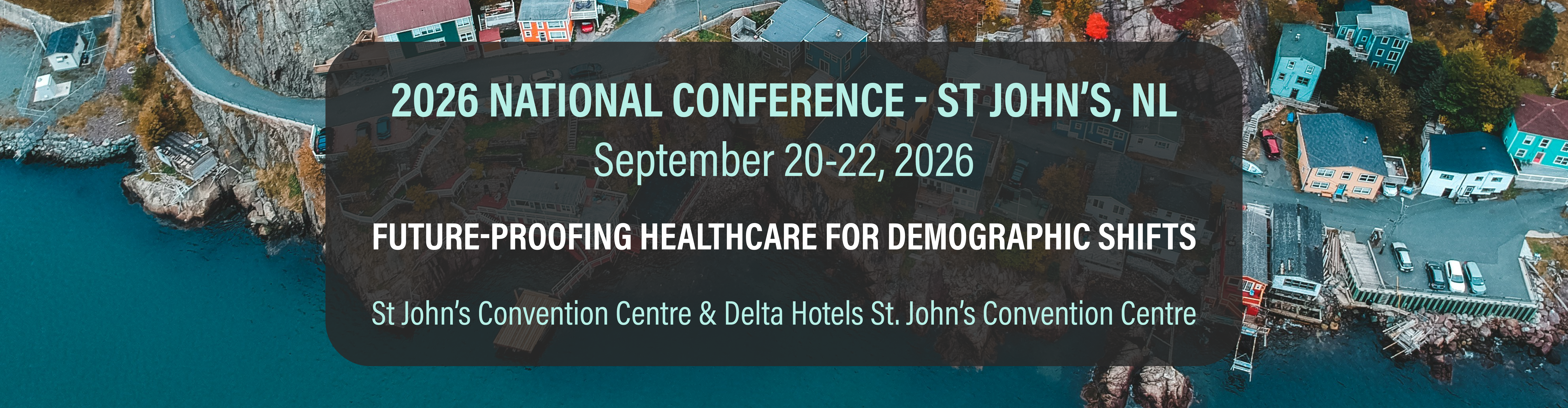
Full Schedule
ALL TIMES ARE SET TO THE TIME ZONE IN St. John's, NL (GMT-2:30)
-
CHES Golf Tournament
The Wilds at Salmonier River Golf Club, 643 Salmonier Line, Route 90 Holyrood, NL A0A 2R0Sunday, September 20 9:00 AM - 4:00 PM
Sponsors
Separate Registration. Shuttle service from Delta St. John's with registration.

-
Boat Tour and Irish Loop Day - Companion Program
Sunday, September 20 9:30 AM - 4:30 PM
Embark on a breathtaking journey along Newfoundland’s Irish Loop, where rugged coastal beauty meets rich history and warm hospitality. This tour winds through charming outports, offering stunning ocean vistas, wildlife sightings, and a deep dive into the island’s Irish heritage.
In the morning, a boat tour out of Bay Bulls will start the day with excitement as you visit the Witless Bay Ecological Reserve to see the last of the puffins before they head South for the winter. After the boat tour, it’s back to the bus for stops in picturesque communities like Cape Broyle, Tors Cove, and Ferryland.
Guests will enjoy a traditional Newfoundland lunch, while encountering fascinating characters, from friendly fishers and storytellers to artisans preserving the island’s heritage. In Renews, the group will stop at Merrymeeting Arts and Crafts for a shop and visit with a one-of-a-kind character.
With every turn, the Irish Loop promises adventure, history, and unforgettable Newfoundland charm.
Includes:
Transportation
Tour guide
Newfoundland-style lunch
Historical site entrance fees


-
Opening Reception - Geo Centre
Johnson Geo CentreSunday, September 20 5:30 PM - 6:30 PM
Geo Centre and Emera Centre - Signal Hill
Shuttle from Delta St. John's to Signal Hill with drop off at the Geo Centre. Groups will move to the Emera Centre after a short visit to the Geo Centre.
-
Opening Reception - Emera Innovation Centre
Emera Innovation ExchangeSunday, September 20 6:30 PM - 8:00 PM
Sponsors

-
Opening Keynote
Avalon Ballroom - Delta HotelMonday, September 21 8:30 AM - 9:30 AM
Speaker
Sponsors


-
From Hotdogs to Health Hub: Adaptive Reuse of a Former Costco into a World-Class Ambulatory Care Facility
Avalon Ballroom - Delta HotelMonday, September 21 9:30 AM - 10:30 AM
Speaker
This session explores how NL Health Services and G architects transformed a former Costco warehouse into a modern ambulatory health hub, demonstrating how adaptive reuse can expand clinical capacity, accelerate project delivery, and reduce environmental impact. Attendees will learn how retail-scale buildings can be reimagined as high-performing healthcare environments through strategic planning, technical innovation, and multidisciplinary collaboration.Session ObjectivesBy the end of this session, attendees will be able to:- Describe the key steps involved in evaluating a large-format retail building for healthcare adaptive reuse.
- Identify the clinical, technical, and operational considerations required to meet CSA and IPAC standards in non-traditional structures.
- Assess the benefits and limitations of adaptive reuse compared to new construction within healthcare infrastructure planning.
- Explain how public–private service integration can support long-term community wellness through mixed-use health hub models.


-
Taste of Newfoundland - Companion Program
Monday, September 21 9:45 AM - 4:45 PM
Become acquainted with the city of St. John's and its surroundings. Enjoy the brilliant vistas from Cabot Tower and Signal Hill. Walk through a cliffside World War II gun battery, watch for whales and seabirds, and visit the oldest standing lighthouse in North America.
Next up, your group will head to Cape Spear, the most Easterly point in North America. On the way back from Cape Spear, we will stop at the famous Chafe’s Landing for lunch. Enjoy a traditional and fresh seafood lunch in the picturesque town of Petty Harbour.
After lunch, your group will visit Newman’s Wine Vaults. At Newman’s, your group will try their famous ‘Port ’ , aged on the island since 1679. Port pairs great with chocolate, especially with that from the Newfoundland Chocolate Company, whose love and passion go into every gourmet batch.
Finally, the tour will finish in Quidi Vidi Village, where your group will visit a local craft brewery to try an assortment of their award-winning beers and hear an interpretation of the origins.
Includes:
Tour guide
Transportation
Lunch at Chafe’s Landing
Newman’s Wine Vault: Sample of Port and Newfoundland Chocolate Company chocolate
Quidi Vidi Brewery: Beer tasting
-
Exhibit Hall Open
Bowring Ballroom-SJCCMonday, September 21 10:30 AM - 5:00 PM
Exhibit hall inactive during session times.



-
Delivering Sustainable Medium-Sized Healthcare Facilities Through Integrated Partnerships
Bannerman 2 & 4Monday, September 21 11:00 AM - 12:00 PM
Speaker
Oak Valley Health is constructing a new 33-bed hospital in Uxbridge through a Design-Bid-Build
(DBB) model, strengthening regional healthcare capacity. The project highlights the importance of
early collaboration among IO, the Ministry of Health, consultants, and hospital teams to align scope,
sustainability goals, and operational resilience. Key priorities include integrating with future LTC
development, meeting LEED Silver and energy-efficiency targets, and ensuring reliable operations
through resilient systems, redundancy planning, and strong facilities and energy.
-
Integrating New Technology to Improve space utilization at Sunnybrook Hospital
Victoria 1-3Monday, September 21 11:00 AM - 12:00 PM
Speaker
Note: this session's previous title was: "From Legacy Spaces to New Fit-outs: Using Near Real-Time Occupancy Intelligence to Transform Operations at Sunnybrook Health Sciences Centre"
Sunnybrook Health Sciences Centre is leveraging near real-time occupancy intelligence to optimize new clinical fit-outs and aging infrastructure. While 3D stereo-optic sensors were integrated into the newly constructed Barzakay Brain Health Clinic and Cipriano Clinic, the methodology was first proven through pilot deployments in existing, high-demand spaces. Combined with thermal-sensor elevator traffic analysis, these initiatives demonstrate scalable, data-driven strategies that enhance patient flow, inform modernization planning, and maximize the performance of new and legacy facilities.
Session Objectives- Understand how near real-time occupancy analytics can be deployed in both new clinical fit-outs and aging infrastructure to improve space utilization, patient experience, and responsiveness to shifting demographic needs.
- Learn how sensor-based elevator traffic analysis in existing facilities supports evidence-based decision-making for modernization planning while still maintaining operational continuity.
- Explore scalable, data-driven strategies for maximizing the value of capital and human resources across diverse facility types.
- Identify how occupancy intelligence helps healthcare organizations adapt to evolving demands such as workforce constraints, infrastructure renewal, and patient flow challenges.
-
Protecting Patients from Extreme Indoor Heat: Lessons from a National Multi-Year Study Across Canadian Health Facilities
Bannerman 1 & 3Monday, September 21 11:00 AM - 12:00 PM
Speaker
Extreme heat is becoming one of Canada’s fastest-growing health threats, yet many health facilities remain unprepared for dangerous indoor temperatures. This presentation shares early results from a national multi-year project led by the Canadian Coalition for Green Health Care assessing heat-health risks in long-term care, acute care, clinics, and home care settings. Using data loggers, surveys, and low-cost interventions, the project identifies practical, scalable strategies to protect vulnerable patients and build climate-resilient care environments.
Session Objectives
- Identify how extreme indoor heat affects patients, residents, and health-care workers across diverse care settings.
- Describe low-tech, high-impact interventions that can immediately reduce indoor heat risks.
- Assess facility preparedness using real-world monitoring tools such as temperature/humidity loggers and heat-health surveys.
- Apply resilience-focused strategies co-designed with communities, demonstration sites, and a national advisory committee.


-
From Blueprint to Bedside: Bridging Design Assumptions and Operational Reality
Victoria 1-3Monday, September 21 12:05 PM - 1:05 PM
Speaker
Sponsors
As demographic and technological shifts transform healthcare, adaptable, efficient, and resilient facilities are essential. This session explores how design assumptions align with operational realities and shares strategies for future-proofing infrastructure. Through the MUHC – Campus Glen case study and AtkinsRéalis’ experience as designer and operator of major Canadian healthcare projects, we’ll highlight lessons learned from design through operation to guide next-generation healthcare facilities.
Session Objectives
- Identify design assumptions that impact long-term adaptability and operational performance.
- Analyze gaps between predicted and actual outcomes at MUHC in energy, maintenance, and flexibility.
- Evaluate strategies for future-proofing healthcare facilities against demographic and technological shifts.
- Apply lessons learned to improve lifecycle planning and resilience in upcoming projects.
-
Shielding Healthcare from Wildfire Smoke: Practical IAQ Strategies for Resilient Facilities
Bannerman 1 & 3Monday, September 21 12:05 PM - 1:05 PM
Speaker
Wildfire smoke events are increasing in frequency and severity, posing significant risks to healthcarefacilities that serve as critical safe havens for vulnerable populations. This session outlines practical strategiesto prevent infiltration of particulate matter, smoke, and odours, and demonstrates how to build an actionablereadiness plan. Attendees will learn how to safeguard indoor air quality (IAQ) and maintain resilientenvironments during climate-driven emergencies.
-
There Must be Something in the Water: Keeping Healthcare Facilities’ Water System Safe through Design, Construction and Maintenance
Bannerman 2 & 4Monday, September 21 12:05 PM - 1:05 PM
Speaker
Sponsors
Bacterial outbreaks from healthcare plumbing systems threaten increasingly vulnerable populations as demographics shift. The upcoming CSA Z317.1 – Special Requirements for Plumbing Installations in Health Care Facilities provides updated standards and tools to help future-proof facilities against waterborne pathogens. With the new edition slated for March 2026, this session will outline key changes and practical strategies CHES members can use to safeguard patients and residents through resilient, sustainable plumbing design and operation.
Session Objectives
After attending this session, attendees will be able to:
- Understand the key risks and contributing factors associated with water system management in healthcare facilities.
- Identify the major updates and new requirements introduced in the upcoming edition of CSA Z317.1.
- Develop a strategy to implement a facility-specific water management program (WMP) that incorporates both preventative measures and response/remediation planning.









-
Checking the Pulse of Your Building: The CSA Z8008 Assessment Standard
Bannerman 2 & 4Monday, September 21 3:00 PM - 4:00 PM
Speaker
Healthcare facilities are complex environments where building performance directly impacts safety, quality of care, and operational reliability. The new CSA Z8008, Assessments of health care facilities, services, and building systems provides a framework for evaluating building condition, functionality, and compliance at the current stage of the facilities’ lifecycle. This presentation introduces CHES members to the standard, assessment types, and how it supports planning for the future with safer, more sustainable, and resilient healthcare facilities.
Session Objectives
- Understand the purpose and scope of the CSA Z8008 Facility Assessment Standard and how it complements and supports other CSA healthcare standards such as Z8000 and Z317.1.
- Understand how the Standard can support healthcare facilities to self-perform or engage consultants to complete unified and coordinate assessments of the functionality of the facility as well as the underlying building system conditions
- Apply the Z8008 assessment framework to guide systems evaluation, performance monitoring, and risk mitigation of existing healthcare facilities.
- Understand how the Standard can assist with evaluating a facility’s ‘fit for purpose’, to determine its functional and technical capability to safely meet complex healthcare needs.
-
Engineering Resilience: Leveraging Forensic Investigations to Future-Proof Aging Healthcare Facilities
Victoria 1-3Monday, September 21 3:00 PM - 4:00 PM
Speaker
Melanie Cairns, Forensic Electrical Engineer and Certified Fire and Explosion Investigator with SMS Engineering, explores how forensic engineering can future-proof aging healthcare facilities.
By identifying root causes of system failures and applying lessons from past incidents, SMS Engineering demonstrates how proactive forensic insights guide infrastructure renewal, optimize capital investments, and enhance patient safety.
Session Objectives
Attendees will gain practical strategies for:
- Revitalizing aging infrastructure through forensic-informed retrofit planning.
- Enhancing climate adaptation and disaster preparedness by learning from past failures.
- Deploying capital effectively by avoiding unnecessary replacements and focusing on root-cause solutions.
- Improving patient and staff safety through targeted upgrades to critical systems.
Attendees will learn practical strategies for integrating forensic diagnostics into lifecycle planning to build resilient, sustainable healthcare environments.
-
Future-Proofing Community Healthcare at PECMH: A Multidisciplinary Roundtable on Mass Timber, Geothermal, and Resilient Design
Bannerman 1 & 3Monday, September 21 3:00 PM - 4:00 PM
Speaker
Sponsors
This multidisciplinary roundtable explores how the new Prince Edward County Memorial Hospital (PECMH) was planned and designed to support the evolving needs of a rural healthcare setting through mass timber construction, geothermal heating and cooling, energy recovery systems, resilient infrastructure strategies, and climate risk analysis.
Representatives from the owner, architecture, mechanical, and electrical engineering teams will discuss how integrated design decisions contribute to long-term adaptability, operational efficiency, patient experience, and future-ready performance.
Session Objectives
By the end of this session, attendees will be able to:
- Identify how rural geographic and service delivery conditions influence infrastructure, system selection, and facility planning at PECMH.
- Describe how coordinated collaboration between owner, architect, mechanical, and electrical teams supported sustainable and resilient design outcomes.
- Assess the role of mass timber, geothermal systems, energy recovery strategies, and climate risk analysis in improving lifecycle performance, operational efficiency, and patient experience.









-
Demand-Controlled Displacement Ventilation - Keystone strategy of a new standard for LTC Design
Bannerman 1 & 3Tuesday, September 22 8:15 AM - 9:15 AM
Speaker
This session will summarize current research findings and best practices from the Displacement Ventilation Emergence in Healthcare (DiVE) multi-year research and engagement initiative that seeks to advance the application of DV in Healthcare. In keeping with the theme, the session will focus on how DV is optimally suited for Long Term Care homes. A growing ""coalition of the willing"" are advocating for DV to become the new default for healthcare. Come join us!
Session Objectives
The learning objectives are for attendees to come away with greater ability to:
- Assess the applicability of DV to their specific context or project
- Identify myths and misconceptions of DV (and be aware of a more accurate perspective)
- Engage interest holders in their context to explore the beneficial application of DV where appropriate
-
Modular and Prefabricated Construction for Remote and Rural Healthcare Projects as a Catalyst for Healthcare Innovation to create Culturally Safe Healthcare Infrastructure
Bannerman 2 & 4Tuesday, September 22 8:15 AM - 9:15 AM
Speaker
Sponsors
Discover how modular and prefabricated construction is transforming healthcare access in remote and Indigenous communities. The Weeneebayko Area Health Authority (WAHA) Redevelopment Project—a $1.8 billion initiative—aims to deliver culturally safe, patient-centered care through rapid, cost-effective infrastructure. Learn how innovative design meets community priorities, reduces construction time, and addresses long-standing barriers to care across the western James Bay and Hudson Bay regions. Join us to explore this groundbreaking approach to equitable healthcare delivery.
Session Objectives
- Identify Barriers to Healthcare Access in Remote Communities
- Assess Cultural Relevance in Healthcare Facility Design
- Explore Modular and Prefabricated Construction Solutions
- Create Community-Engaged Implementation Strategies
-
Yellowknife 2023 Wildfire Evacuation: A Firsthand Look at Health-System Fragility in a Climate Emergency
Victoria 1-3Tuesday, September 22 8:15 AM - 9:15 AM
Speaker
When Yellowknife was ordered to evacuate during the 2023 wildfires, more than 20,000 residents — including a 100-bed hospital — were displaced over 1,500 kilometres away. The crisis exposed major gaps in climate readiness, later underscored when wildfire smoke infiltrated Yellowknife’s brand-new hospital, reaching hazardous levels in the neonatal unit caring for a preterm infant. This presentation uses firsthand experience to highlight urgent actions needed to build smoke-ready, evacuation-ready, climate-resilient Canadian health facilities.





-
CHES National Annual General Meeting
Bannerman 2 & 4Tuesday, September 22 9:30 AM - 10:15 AM

-
Blueprints for Tomorrow: Futureproofing Healthcare in an Era of Change
Victoria 1-3Tuesday, September 22 1:15 PM - 2:15 PM
Speaker
Sponsors
From economic policy changes to shifting demographics, artificial intelligence to alternate project delivery, shifting care sites to specialty care services, carbon reduction to climate resiliency – lets take a deep dive into the current health sector trends and how they are shaping our world.
In this high energy, high impact presentation, Tariq will take the audience on an evidence based deep dive into the trends that are shaping the delivery of health across the country.
Session Objectives
- Analyze the Impact of Demographic and Policy Shifts: Examine how slowing population growth, aging demographics, and evolving policy trends are influencing healthcare service demand, care models, and workforce challenges.
- Explore Flexible and Futureproof Healthcare Planning: Discuss strategies for designing adaptable healthcare facilities and masterplans that can respond to changing technologies, care delivery models, and climate resiliency needs.
- Evaluate the Role of Artificial Intelligence and Intelligent Design: Assess how artificial intelligence and intelligent design solutions are transforming healthcare operations, reducing capital construction costs, and improving patient outcomes.
- Identify Approaches for Sustainable and Specialized Care Delivery: Review methods for balancing economic constraints, technological integration, and specialty service expansion to ensure healthcare systems remain responsive and sustainable for all age groups.
-
Buildings can Harm or Heal Us – Let’s Choose Health
Bannerman 2 & 4Tuesday, September 22 1:15 PM - 2:15 PM
Speaker
This session will present steps to harness the power of indoor air quality (IAQ) management to decrease healthcare-associated infectionss, promote patient healing, improve staff productivity and satisfaction, and sustain hospital financial viability.
Session Objectives
- Articulate the impact of indoor environments on both infectious and non-infectious diseases
- Design and operate buildings according to real-time and predicted indoor and outdoor air quality
- Create cost/benefit analyses that include the value of healthy occupants
-
Why Are so Many New Hospitals So Energy Inefficient?
Bannerman 1 & 3Tuesday, September 22 1:15 PM - 2:15 PM
Speaker
Sponsors
More than 100 new hospitals open annually in North America, yet only a small fraction meet high energy-performance standards. Most overspend on utilities and emit tens of thousands of avoidable tonnes of GHGs. Cortellucci Vaughan Hospital, opened in 2021, is a standout at about 33 ekWh/ft², making it one of the most efficient major acute care hospitals in a cold climate. This session presents key findings from recent hospital projects to help deliver consistently high-performance
Session Objectives
- Assess the actual energy intensity of recently opened and planned hospitals.
- Identify where failures in the new hospital development process have the biggest impact on final energy performance.
- Explain the importance of energy targets, commissioning and facility management in energy performance.
- Engage in this ongoing research to achieve better energy performance outcomes in your hospital.



-
Engineering a Net-Zero-Carbon-Ready Pediatric Hospice Through Integrated Mechanical Systems and Therapeutic Architecture
Bannerman 1 & 3Tuesday, September 22 2:30 PM - 3:30 PM
Speaker
Sponsors
Keaton’s House Children’s Hospice is a first-of-its-kind pediatric hospice in the Hamilton region, designed as a Net Zero Carbon Ready, 24-hour clinical care environment. This session explores how mechanical, electrical, and passive systems were engineered in tandem with a domestic, single-storey architectural form to deliver resilience, clinical safety, and profound emotional support. Attendees will learn how engineering strategy, sustainability, and therapeutic design converged to create a model for future pediatric hospice environments.
Session Objectives
- Describe the integrated mechanical and passive design strategies used to achieve Net Zero Carbon readiness in a 24-hour pediatric care environment.
- Identify the engineering requirements unique to pediatric hospice programs and how they inform ventilation, filtration, and thermal comfort solutions.
- Assess how single-storey architectural planning enhances system efficiency, clinical responsiveness, and operational resilience.
- Explain how engineering decisions support therapeutic goals, sensory regulation, and culturally significant practices within a hospice setting.
-
Harnessing AI and Intelligent Infrastructure for Sustainable, Reliable Care
Victoria 1-3Tuesday, September 22 2:30 PM - 3:30 PM
Speaker
Healthcare facilities face increasing threats from climate events, cyber risks, and aging infrastructure. This session explores how artificial intelligence (AI) and intelligent building solutions transform resiliency—enabling proactive risk management, sustainability, and reliable care delivery. Through real-world case studies and strategic frameworks, attendees will gain practical insights for leveraging advanced technologies and collaborative approaches to future-proof health systems and promote operational, environmental, and business success.
Session Objectives
- Evaluate the evolving definition of healthcare resiliency and why it matters.
- Identify practical applications of AI and smart infrastructure for risk mitigation, sustainability, and reliability.
- Explore case studies demonstrating measurable benefits in energy costs, patient experience, and environmental impact.
- Develop a strategic roadmap for implementing resilient and sustainable practices in healthcare facilities.
-
Maison des Aînées Alternative – A New Vision for Long-Term Care in Quebec
Bannerman 2 & 4Tuesday, September 22 2:30 PM - 3:30 PM
Speaker
Sponsors
Quebec’s Long-term Care Facilities: Maisons des Aînés — An Electromechanical Perspective
Context:
The province of Quebec, like many regions around the world, was severely affected by the COVID-19 pandemic. Long-term care facilities were among the hardest hit, and the quality of these existing institutions was rightfully questioned and criticized.
Objectives:
Enhance contamination control, improve resident comfort, discreetly integrate healthcare systems, and create warm, home-like, innovative environments for long-term care facilities.
Session Objectives
- Describe Quebec's vision to improve Long-term Facilities in order to provide a better quality of life for our Elderies;
- State Quebec's post-COVID challenges in long-term care facilities;
- Assess the electromechanical considerations for a new model of long-term care facilities;
- Identify the key factors that help create a “home-like” environment in long-term care facilities.







-
Refreshment Break in Exhibit Hall
Bowring Ballroom-SJCCTuesday, September 22 3:15 PM - 3:45 PM
-
Closing Keynote
Bannerman 2 & 4Tuesday, September 22 3:45 PM - 4:45 PM
Speaker
Sponsors
Topic: Finding Joy in Your Life
Life will always bring challenges, but italso offers countless opportunities for joy. When we shift our focus fromwhat we've lost to what we've been given, we discover that joy isn'twaiting for us someday—it has been beside us all along.